


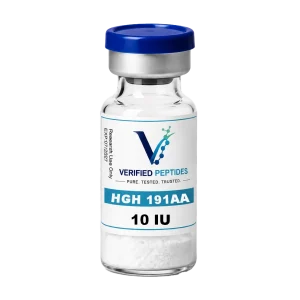

HGH 191AA
Price range: $45.00 through $170.00
HGH 191AA (Human Growth Hormone 191 Amino Acid) is the bioidentical form of somatropin, the growth hormone naturally produced by your pituitary gland. Unlike older 192AA formulations that contained an extra methionine amino acid, HGH 191AA is structurally identical to what your body produces, making it the gold standard in growth hormone research and therapy.
HGH 191AA (Human Growth Hormone 191 Amino Acid) is the bioidentical form of somatropin, the growth hormone naturally produced by your pituitary gland. Unlike older 192AA formulations that contained an extra methionine amino acid, HGH 191AA is structurally identical to what your body produces, making it the gold standard in growth hormone research and therapy.
This comprehensive guide covers everything you need to know about HGH 191AA: how it works, the difference between 191AA and 192AA, research-backed benefits, dosage protocols, side effects, proper storage, and frequently asked questions. Whether you’re exploring HGH for medical purposes or research, this guide provides the scientific foundation you need.
What is HGH 191AA?
Definition & Overview
HGH 191AA (also written as HGH-191aa or Somatropin) is recombinant human growth hormone that consists of exactly 191 amino acids—the identical sequence produced by somatotropic cells in the anterior pituitary gland. The “191AA” designation specifically indicates this bioidentical structure, distinguishing it from older synthetic variants.
Human growth hormone is a single-chain polypeptide hormone essential for:
- Growth and development during childhood and adolescence
- Metabolism regulation throughout life
- Body composition maintenance (muscle mass, fat distribution)
- Cellular repair and regeneration
- Bone density preservation
The History of Synthetic HGH
1950s-1985: Cadaver-Derived HGH
The first growth hormone treatments used HGH extracted from human cadaver pituitary glands. This method was discontinued in 1985 after cases of Creutzfeldt-Jakob disease (CJD) were linked to contaminated batches.1985: Introduction of Recombinant HGH
Genentech introduced the first recombinant human growth hormone (Protropin), produced using recombinant DNA technology in E. coli bacteria. This 192AA version contained an extra N-terminal methionine.1987: True 191AA HGH
Eli Lilly introduced Humatrope, the first true 191AA recombinant HGH that was structurally identical to natural human growth hormone. This became the new standard.Today: Multiple 191AA Products
All modern pharmaceutical-grade HGH products (Genotropin, Norditropin, Humatrope, Omnitrope, Saizen) are 191AA formulations.Key Facts About HGH 191AA
Property Specification Amino Acids 191 Molecular Weight ~22,124 Da (22 kDa) Structure Single-chain polypeptide with 2 disulfide bonds Half-Life 2-3 hours (plasma) Administration Subcutaneous or intramuscular injection Dosing Frequency Once daily (typically evening) Storage Refrigerated (2-8°C / 36-46°F)
HGH 191AA vs 192AA: Key Differences
One of the most important distinctions in growth hormone products is the difference between 191AA and 192AA formulations. Understanding this difference is crucial for anyone researching or using HGH.
Structural Difference
191AA (Somatropin)
- Contains exactly 191 amino acids
- Structurally identical to endogenous (natural) human growth hormone
- No extra amino acids attached
- Examples: Humatrope, Genotropin, Norditropin, Omnitrope
192AA (Somatrem / Met-hGH)
- Contains 192 amino acids
- Has an extra N-terminal methionine (Met) attached
- Also called “methionyl human growth hormone” or “met-hGH”
- Historical example: Protropin (discontinued)
Immunogenicity & Antibody Formation
The extra methionine in 192AA creates a key concern:
192AA Issues:
- The body may recognize the extra methionine as “foreign”
- Can trigger antibody formation against the growth hormone
- Antibody formation increases with use beyond 4 months
- Some users experience injection site reactions (redness, swelling)
- May reduce effectiveness over time due to antibody binding
191AA Advantages:
- Bioidentical to natural HGH—body recognizes it as “self”
- Significantly lower risk of antibody formation
- Better tolerated for long-term use
- Fewer injection site reactions
Bioactivity Comparison
Interestingly, research has shown that the bioactivity of both forms is essentially equivalent:
“The bioactivity assessed by both in vitro cell proliferation assays and in vivo bioassays failed to distinguish between the two hormones. The NH2-terminal methionine on bacterially derived growth hormone results in altered antigenicity without any measurable effect on bioactivity.”
This means both 191AA and 192AA will produce similar biological effects in the short term. However, the potential for antibody formation with 192AA can reduce effectiveness over time.
Why 191AA is the Standard Today
Factor 191AA 192AA Structure Bioidentical to natural HGH Extra methionine attached Antibody Risk Low Higher (especially >4 months) Pharmaceutical Availability All current brands No current pharmaceutical brands Long-term Tolerance Excellent May decrease over time Injection Site Reactions Minimal More common Cost Standard N/A (not commercially available) Bottom Line: If you’re using or researching HGH, ensure it’s a 191AA formulation. There are no legitimate pharmaceutical 192AA products currently on the market—any 192AA products are from non-pharmaceutical sources and may have additional quality concerns.
How HGH 191AA Works: Mechanism of Action
Understanding how HGH 191AA works at the cellular level helps explain its wide-ranging effects on the body.
The GH-IGF-1 Axis
HGH 191AA exerts its effects through two primary mechanisms:
1. Direct Effects
HGH binds directly to growth hormone receptors (GHR) on target cells throughout the body. When HGH binds to these receptors, it triggers intracellular signaling cascades that influence:
- Cell growth and division
- Protein synthesis
- Fat metabolism (lipolysis)
- Glucose regulation
2. Indirect Effects (via IGF-1)
The majority of HGH’s anabolic effects are mediated indirectly through Insulin-like Growth Factor 1 (IGF-1):
- HGH stimulates the liver to produce and secrete IGF-1
- IGF-1 then circulates throughout the body
- IGF-1 binds to its own receptors, promoting growth and anabolic effects
- This is called the “somatomedin hypothesis”
Cellular Signaling Pathways
When HGH binds to the growth hormone receptor, it initiates several key signaling pathways:
JAK-STAT Pathway:
- HGH binds to GHR, causing receptor dimerization
- Janus kinases (JAK1 and JAK2) are activated
- JAKs phosphorylate STAT proteins (STAT1, STAT3, STAT5)
- Activated STATs translocate to the nucleus
- Gene transcription is initiated, leading to:
- IGF-1 production
- Protein synthesis
- Cell proliferation
MAPK Pathway:
- Influences cell differentiation and proliferation
- Important for metabolic regulation
PI3K-Akt Pathway:
- Promotes cell survival and growth
- Influences glucose and lipid metabolism
Natural Regulation of GH
Your body tightly regulates growth hormone through a feedback system:
Stimulators of GH Release:
- GHRH (Growth Hormone-Releasing Hormone) from the hypothalamus
- Ghrelin from the stomach
- Sleep (deep sleep stages)
- Exercise
- Low blood glucose
- Stress
Inhibitors of GH Release:
- Somatostatin (Growth Hormone-Inhibiting Hormone)
- High blood glucose
- IGF-1 (negative feedback)
- Elevated free fatty acids
Pulsatile Secretion Pattern
Natural GH is released in pulses, not continuously:
- Major pulse during deep sleep (stages 3-4)
- Smaller pulses throughout the day
- Total daily production: ~0.4-1.0 mg in adults
- Production decreases with age (~14% per decade after age 30)
Synthetic HGH 191AA mimics these effects but is typically administered once daily, creating a more sustained elevation rather than natural pulsing.
Benefits of HGH 191AA
Research and clinical experience have documented numerous benefits of HGH therapy in individuals with growth hormone deficiency. Below are the evidence-based benefits:
1. Body Composition Improvements
Increased Lean Body Mass
HGH stimulates protein synthesis and promotes muscle growth:
- Studies show 5-10% increase in lean body mass over 6-12 months
- Enhances muscle protein synthesis (MPS)
- Inhibits muscle protein breakdown (MPB)
- Improves nitrogen retention
Reduced Body Fat
HGH is highly lipolytic (fat-burning):
- Promotes breakdown of stored triglycerides
- Increases fatty acid oxidation
- Preferentially reduces visceral (abdominal) fat
- Studies show 10-20% reduction in body fat
- Enhances metabolic rate
2. Metabolic Benefits
Improved Lipid Profile
- Reduces LDL (“bad”) cholesterol
- May increase HDL (“good”) cholesterol
- Decreases triglycerides
- Reduces cardiovascular risk markers
Glucose Metabolism
- Complex effects on glucose
- Can cause insulin resistance at higher doses
- Lower doses may improve metabolic health
- Monitoring blood glucose is recommended
3. Bone Health
Increased Bone Mineral Density
- Stimulates osteoblast (bone-building cell) activity
- Enhances calcium absorption
- Improves bone turnover markers
- May reduce fracture risk over time
- Effects may take 12-24 months to manifest
4. Skin, Hair & Connective Tissue
Collagen Synthesis
- Stimulates fibroblast activity
- Increases collagen production
- Improves skin thickness and elasticity
- May reduce wrinkle depth
- Enhances wound healing
Hair & Nails
- May improve hair thickness
- Can enhance nail growth and strength
5. Recovery & Healing
Tissue Repair
- Accelerates wound healing
- Enhances recovery from injuries
- Improves surgical recovery times
- Supports tendon and ligament repair
- Reduces recovery time between training sessions
6. Cognitive & Psychological
Quality of Life
- Improved energy levels
- Enhanced mood and well-being
- Better sleep quality
- Reduced anxiety and depression symptoms
- Improved cognitive function (memory, concentration)
7. Cardiovascular Function
Heart Health
- May improve cardiac output
- Enhances exercise capacity
- Improves endothelial function
- Potential reduction in cardiovascular mortality
| Specification | 6iu*10vials, 8iu*10vials, 10iu*10vials, 12iu*10vials, 15iu*10vials, 24iu*10vials, 36iu*10vials, 40iu*10vials |
|---|
Be the first to review “HGH 191AA”
Related products
Szjpbiotech

Szjpbiotech
Szjpbiotech
Szjpbiotech
Szjpbiotech
Szjpbiotech

Szjpbiotech

Szjpbiotech
Reviews
There are no reviews yet.