
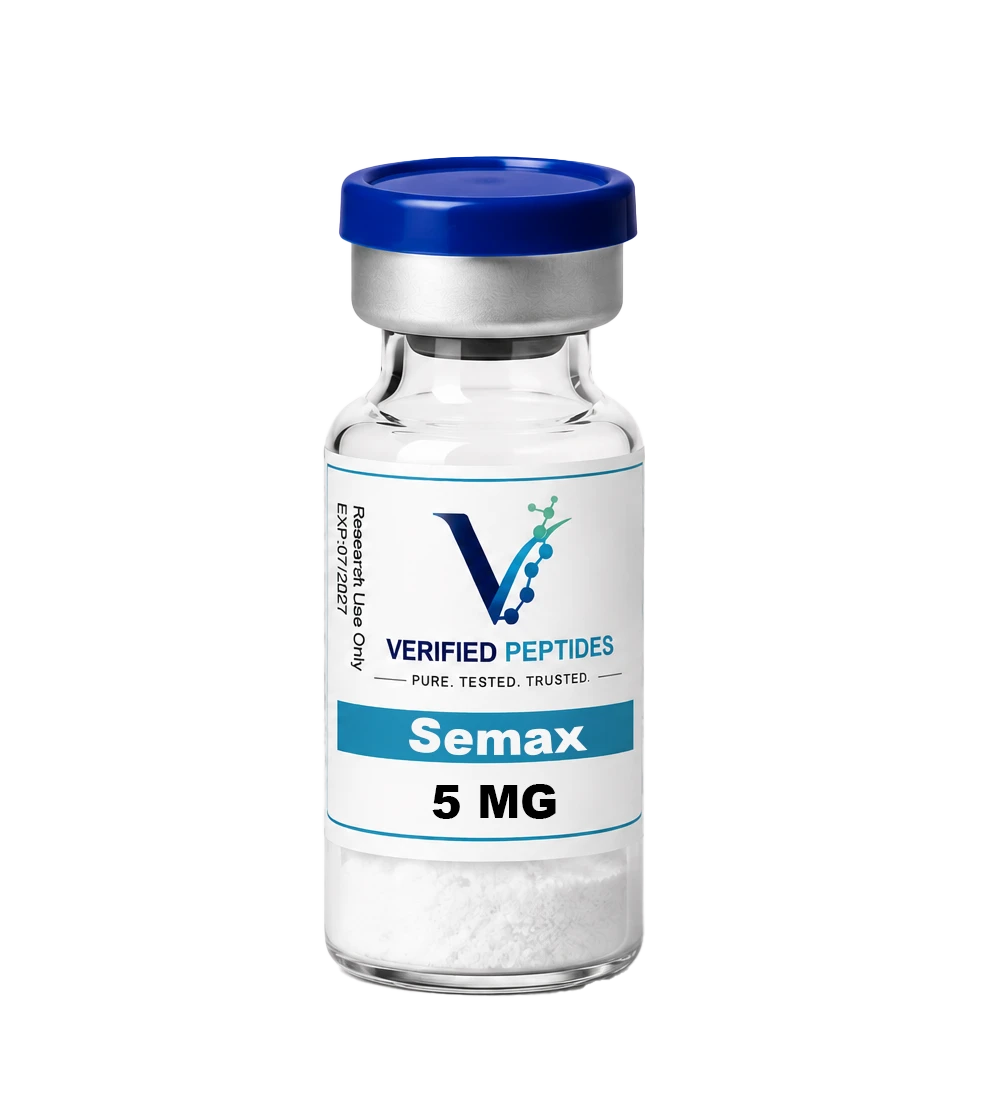
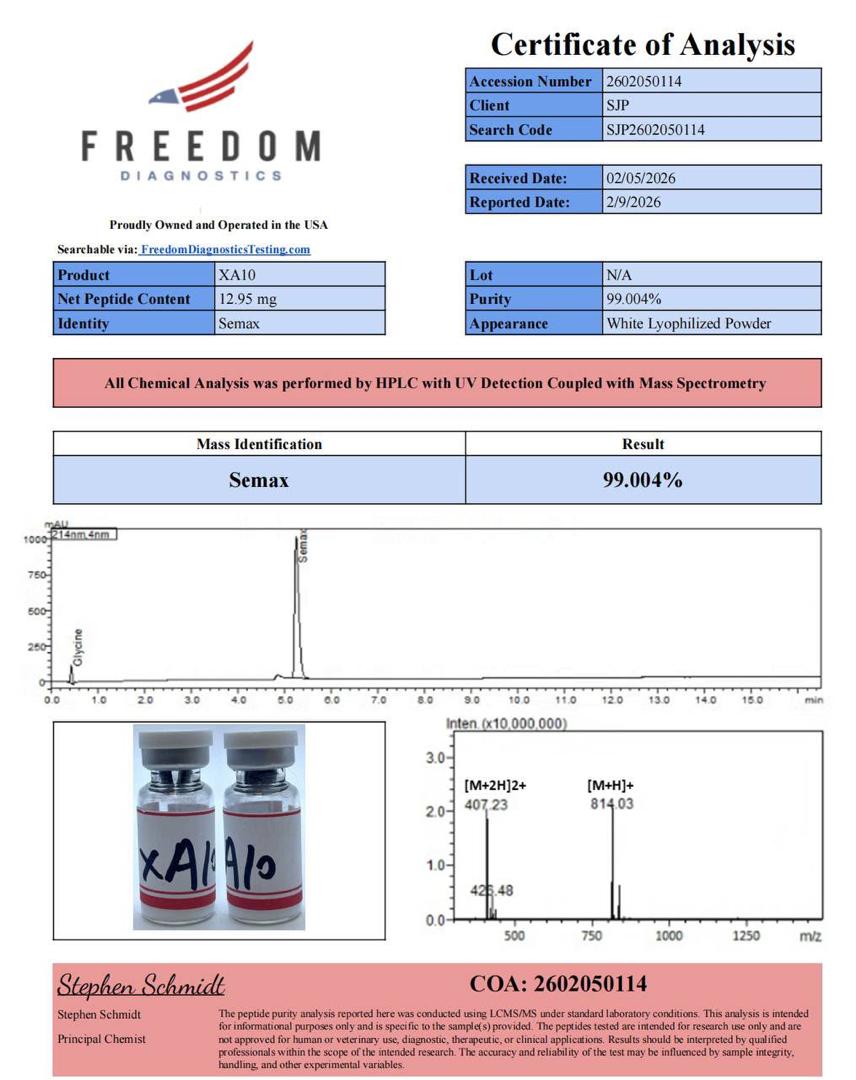

Semax Peptide
Semax peptide is a synthetic polypeptide analog of an adrenocorticotropic hormone fragment 4-7 (ACTH 4-7),(1) a hormone secreted by the anterior pituitary gland. This fragment has been reported by researchers not to exhibit any action characteristic of ACTH itself but may have a potentially specific action within the brain.(2)
Researchers find that naturally occurring peptides may occasionally exhibit instability and easy degradation by biological enzymes, such as those found in gastrointestinal and cerebrospinal fluids. Consequently, researchers aim to synthesize analogs of these naturally occurring but potentially unstable peptides to induce similar biological action with the added value of higher stability. Semax is one such synthetically developed derivative of an endogenous adrenocorticotropic hormone fragment. The Met-Glu-His-Phe sequence in Semax is extended by adding a Pro-Gly-Pro (PGP) sequence at its C-terminal end. This modification with PGP may potentially enhance the molecule’s ability to cross the blood-brain barrier (BBB) by increasing its lipophilicity. This increase in lipophilicity may facilitate the molecule’s passive diffusion or uptake through mechanisms such as lipid raft-mediated endocytosis, which may circumvent the tight junctions that typically restrict entry into the brain. Furthermore, the presence of PGP at the peptide’s C-terminus might also modify its interactions with specific transporters or receptors on the BBB, potentially favoring its transport via receptor-mediated transcytosis. Moreover, the acetylation of Semax may improve its stability by making it more resistant to enzymatic breakdown, thereby extending its half-life in biological settings.
Overview
Synthetically developed Semax has been widely researched for its potential mechanism of action and lauded for its apparent biological stability. Researchers suggest it may inhibit select enzymes that regulate the degradation of enkephalins, naturally released neurotransmitters secreted in the brain, which scientists consider may regulate several biological functions. Enkephalins are believed to be significantly involved in nociception (the sensory perception of pain) and stress response. Moreover, an elevation in enkephalin concentrations might potentially impact other neurotransmitter systems due to the intricate interconnections between the opioid system and neurotransmitters such as dopamine and serotonin. This interaction may manifest through modulation or alteration of neurotransmitter release, receptor activity, or signal transduction pathways, indicating a sophisticated and multifaceted relationship that remains an area of active research. In addition to enkephalins, Semax has been evaluated for its potential to inhibit other peptide-degrading secreted enzymes.
Based on one specific research study,(4) Semax may induce elevated secretion and release of dopamine as well as possibly increasing the levels of brain-derived neurotrophic factor (BDNF). Based on another study,(5) Semax has been speculated to also host the potential to alter gene expressions that modulate the immune system. In altering gene expression, the levels of immune cells and their mobility may be elevated. Semax was reported by researchers to exhibit altering potential in the encoding of chemokines and immunoglobulins, related to the functioning of the vascular system.
Chemical Makeup
Molecular Formula: C39H54N10O10S
Molecular Weight: 854.99 g/mol
Other Known Titles: ACTH (4-7)PGP, HY-P1146
Research Studies and Clinical Trials
Semax Peptide and Nootropic Action
An initial study(6) was conducted on ACTH hormone and its analogs, including Semax, to determine its nootropic potential in murine models. After peptide exposure in the models, 5-hydroxyindoleacetic acid (5-HIAA) levels were monitored. 5-HIAA levels appeared elevated by 25% after 2 hours of Semax presence. The levels appeared to increase gradually up to a maximum of 180% within 4 hours of peptide exposure. It was noted by researchers that the peptide, when introduced 20 minutes before D-amphetamine, appeared to lead to an elevation of 5-HIAA as compared to exposure to Semax alone. 5-HIAA is a primary metabolite of serotonin, which indicates that Semax might enhance serotonergic activity. This hypothetical influence on serotonin metabolism might enhance the functions of serotonin-dependent pathways, which may affect operations within the central nervous system. This speculative action underscores a possible modulation of neurotransmitter systems that play critical roles in mood, cognition, and overall brain function.
Semax Peptide and Neonatal Anxiety Models
The main aim of this study(7) was to expose neonatal murine models to an SSRI and then Semax, to evaluate the interaction. Murine models aged between 1 and 14 days received an SSRI, followed by Semax on days 15 to 28. After 28 days, it was noted that upon exposure to the SSRI, the rats exhibited anxiety-like behavior, with an apparently impaired response to stressors and new stimuli during the first 14 days. Following Semax exposure, these SSRI-induced actions appeared to be mitigated, with the rats even exhibiting improved learning abilities and an overall reduction in anxiety-driven behaviors. Researchers posited that Semax might have reestablished normal levels of monoamines in the brain, which may have been initially decreased by the SSRI. By affecting these neurotransmitter systems, Semax might restore or stabilize neural pathways that were previously disrupted. Such changes might balance the excitatory and inhibitory signals in the brain, creating a state more conducive to reduced anxiety. For instance, by potentially increasing serotonin levels, Semax may improve mood and decrease anxiety, while optimizing dopamine might enhance motivation and reward processing. Furthermore, norepinephrine adjustments might improve attention and vigilance. Behavioral assessments conducted in the experiment indicated that these potential actions of Semax appeared temporally stable. The reduction in anxiety-related behaviors was sustained from adolescence through young adulthood, suggesting that Semax might have a lasting influence on neural circuits. This enduring stability implies that Semax might support creating a protective or corrective action on these circuits that persists beyond immediate exposure.
| Specification | 5mg*10vials, 10mg*10vials |
|---|
Be the first to review “Semax”
Related products
Szjpbiotech
Szjpbiotech
Szjpbiotech
Szjpbiotech

Szjpbiotech

Szjpbiotech
Szjpbiotech

Szjpbiotech
Reviews
There are no reviews yet.